Why Customer Acquisition Is What Brands Now Want
Back in the dark ages, which in the world of marketing is the period from around 2010-2016, CPA was the undisputed champion of all marketing metrics. We paid for clicks, we brought people to websites, they bought something, and we divided the amount we spend by the number of orders to calculate the cost per action; CPA.
Ecommerce was hard to get into, wholesale goods were cheap to buy so margins were high, and CPA was easy to track. The whole thing made sense.
Then things started getting more competitive in the world of ecommerce, more and more stores started popping up which drove down margins and many retailers started realising that if their customers bought their cheaper items then they would often lose money. CPA started going out of fashion with the realisation that the value of sales is the more important metric, and with better tracking enabling more sites to easily track their revenue from advertising the industry quickly shifted to focusing on return on ad spend, or ROAS.
Lower Margins Make ROAS Ineffective
Towards the end of 2023 another set of shifts has taken place. Margins have been squeezed even more for most ecommerce stores with higher costs for buying from suppliers and consumers becoming more price sensitive than ever.
Like when the world moved away from focusing on CPA, the marketing industry is coming to the realisation that for many stores all ROAS is not equal. Margin is all important, and for more and more retailers they are finding it simply impossible to hit their ROAS targets.
As a result, we’re currently seeing large numbers of brands moving their target once again to now focus on customer acquisition cost, or CAC.
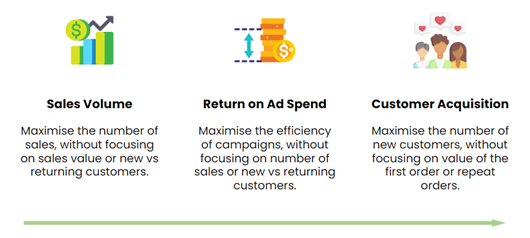
In some ways this feels like a step back to the world of CPAs, but the crucial difference is that optimising for CPA means spending money on advertising for any sale, whereas optimising for CAC means only being concerned with spending money on advertising to generate new customers who have not previously shopped with the brand before.
This has a number of advantages. Firstly it removes problems with revenue tracking which often under-report the amount of revenue a channel is generating and therefore makes ROAS look worse. Secondly, it pushes marketers to reduce spend on repeat customers, these people are typically easier to sell to and so the ad platforms have a habit of ‘goal hanging’ and disproportionately spending on the low hanging fruit. Thirdly and perhaps most importantly, it opens up the possibility to run campaigns specifically focused around impulse purchase products or sample items to get people into a brand.
These items will typically have a low price point and not look good on a ROAS basis, not be worthwhile on a CPA basis where they are marketed to repeat customers, but can be a fantastic way of increasing customer count and quickly increasing the number of active customers who can be inexpensively encouraged to come back for more.
Ad Inflation Is The Final Problem For ROAS
The real nail in the coffin for ROAS is the increasing cost of online advertising. Our annual industry report shows that while general inflation in the UK is now down to just 2% in the year to June 2024 while inflation in ad costs is at a staggering 9%.
Driving sales and making a profit on the first order is no longer a viable option for most online stores which is leading to more long term thinking and making a profit on the second or third order that a customer places.
If ROAS still works for your brand, stick with it, but we would recommend at least trying to figure out how much of your revenue from ads is driven by existing customers. If it’s high, you might be a victim of ad platform goal hanging and maybe a shift to CAC could be the right move for you.
Get Started
.svg)

.png)





.png)